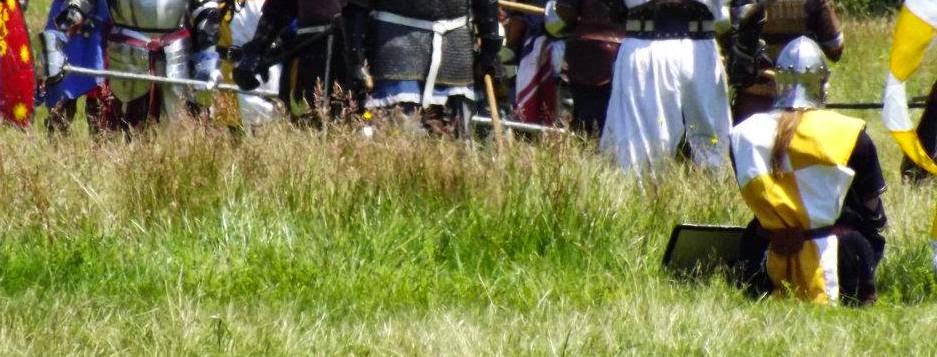
The fight starts before the armor, before you pick up your stick, and before you step onto the field. It begins with an individual that is devoted to himself and understands the gravity of taking up arms against his fellow man.

Showing posts with label Trainning. Show all posts

Thursday, May 3, 2012

On 11:16 AM by Unknown in ,     No comments
I've increased the intensity of my workouts and switched to more of a CrossFit style that focuses on both strength and conditioning.  The constant varied, high intensity, movements are aimed at improving general physical preparedness across a broad range of times and situations.  These workouts are typically short, 20 minutes or less, and demand all-out physical exertion.  They combine movements such as sprinting, rowing, weightlifting, and rope climbing as well as plyometrics and other exercises that rely on body weight.

To improve my cardio I run everyday.  Not the same distance mind you but consistently to ensure my body adapts and grows the capillaries I need to stay strong throughout a race.  I've found a pace that I can keep for over four miles, approximately 9:45 minutes per mile, which is not where I want to be but the stability throughout the run is more important right now as I train my knees to deal with my activity level.  Monday was my rest day, so on Tuesday I ran 4.5 miles in 40 minutes.  Yesterday I did 20 minutes of HIIT, or high intensity interval training, on the elliptical and managed to shave 40 seconds off of my 2.25 mile run time.  Overall I'm please with this result.  This means my 5k race time should be much better, and that defeating the obstacles will take less time.  I also stretched well after the run to keep my muscles from becoming too stiff with all the back-to-back workouts I've been doing.

Nutrition is also in the forefront of my mind.  I burn quick and need to remember I'm not doing this to loose weight but to gain muscle and strength.  It is difficult for me to increase the amount and type of foods that I need when I see friends slamming protein shakes instead of eating meals.  Their calorie intake is not MY calorie intake and I need to remember to focus on what is best for my training not just what everyone else is doing. 

Sword training is moving forward.  If I can get my body to catch up with my mind I could have a bit more synergy during my fights.  Working on the pel is helping greatly.  Here I can go through the blows slowly, pick apart footwork, body mechanics and hip shifts all of which are slowly becoming muscle memory.  It's definitely a bit of a grind but the results are well worth it.  Getting a camera set up so I can post videos of training/practice sparing/etc..as well as learn how to critique them.  Comments in the future are encouraged.

Friday, April 20, 2012

On 5:20 PM by Unknown in     No comments
A few nights each week are devoted specifically to different aspect of my training.  Mondays and Thursdays are sparing practices, and Wednesday nights are one-on-one with my Knight.  This week we armored up and ran through a couple of drills.  Some initial movement and blocking ensued, where one person was solely offensive and the other only defended.  Being able to read body motion is important otherwise there are gaps in defense.  This drill forces you to adjust your sword and shield positioning as well as teaches you that stepping toward or away from your opponent can be just as effective as blocking with your shield.

The second drill was learning a basic pump fake.  By drawing your hand forward without committing your body to a blow, you can fool your opponent into moving there defense in anticipation of the shot.  Thus creating an opportunity to kill you opponent in a very energy conserving manor.

The third drill focused on something referred to as "sheathing the sword".  Throwing the on-side snap to the head and the recovery bringing your hand down in a tear drop toward your left hip, known as "sheathing the sword",  to throw an offside body/leg/head depending on the openings available.  Of course one must bring the shield up to protect the head otherwise you've tangled yourself up something fierce.

Wednesday, February 22, 2012

On 1:49 PM by Unknown in     No comments


Being coach-able requires a set of interpersonal skills that allow the fighter to learn, grow and achieve their potential.  To grow to potential a fighter needs to first begin by listening to their instructor. This requires active listening to what is being said, by the instructor, and not thinking about what they want to say in response.  If  too much time is spent thinking about your response then your not open to what is being said.  This leads to spending more time defending the ego instead of accepting you do not know everything and that you may learn something from the advice being given.

Second, the fighter needs to understand their emotions and reactions. When receiving criticism, constructive or not, some emotions over take them and they may begin to feel embarrassed or angry. When this happens they become defensive and in some cases completely shut down.  Understanding that on the path to reaching your potential it is crucial to be able to manage these emotions and be open to feedback.  Once this is achieved the fighter can then choose to accept the feedback and take direction to change or ignore it.  Different skills work for different people so some feedback may not be as constructive as others.  Hopefully your instructor can provided specific examples of how to improve and what to do. If not, the fighter needs to ask questions to clarify what will help them improve and what steps to take to achieve it.   If you are unsure about how to improve you also need to step up and ask for feedback about fighting performance.


Here are some thoughts from a few conventional sports trainers on the subject.   


Andy Petranek, owner/founder of CrossFit Los Angeles, says coach-able athletes have the following qualities:

They're humble. They're okay slowing down for the sake of learning form. They are usually master technicians. They think long-term. They measure progress in months and years versus day by day. They're competitive with themselves as much or more than with others. They have a good sense of humor and don't take things too seriously. They practice things on their own. They're willing to try new things. They aren't hung up on doing things the way they always have. They look toward change. They're willing to take risks. They're respectful. They know they don't know it all.

Barbara Skiba, a retired field hockey coach, looked for athletes who:

  • Are committed to the sport
  • Love the game/activity
  • Respect coaches, teammates, and opponents
  • Accept responsibility for outcome of contest; don't make excuses for losses
  • Work hard at practice as well as games
  • Exercise self control on and off the field of play
  • Possess confidence but not arrogance
  • Possess inner strength; able to control emotional responses and concentrate on what has to be done in pressure situations
  • Are competitive, but have fun and enjoy the game
  • Are able to set their ego aside and learn to adapt.


Tuesday, February 7, 2012

On 9:32 AM by Unknown in     No comments
One of the privileges of training with a high profile instructor is the opportunity to watch fighters in the upper bracket practice and discuss techniques.  Over the next month a small group, around 7, will be focusing on tournaments.  Twice a week the group will be filmed fighting a double round robin.  The idea is to gear up, warm-up, fight, then immediately review the video footage.  By reviewing the footage so quickly the fighters and the instructor can break down mental game and technique while the fights are fresh in their minds.  An overall improvement in performance is expected by stressing the importance of a few fights.  The constant rebuilding of paradigms, or situational mind-sets, will hone focus and help the fighters ability to be successful during tournaments.

For myself I took a week off.  The injuries, illness, and some uncomfortable fights were leaving a bitter taste in my mouth.  Instead of mopping around and increasing my discontent, I gave myself time to clear my head, heal, and rediscover the reasons for stepping onto the ring.  Turns out it was just what I needed.

Thursday, February 2, 2012

On 6:40 PM by Unknown in ,     No comments
Throwing shots on the pel

1)   Find your maximum range and take up position
      Throw shot, moving forward.  Stay light on your feet.
      Strike thru target, keeping hand above shoulder level, and connect with pel.
      Your hand should end the blow just above the level of the opponents right shoulder.

2)   From first ending position
      Start movement in desired direction and pivot hand toward offside blow.
      Keep elbow tucked toward body to shorten rotational axis. (This also prevents you from throwing too much arm into this reversal shot and injuring your shoulder.)
     
3)   Adjustment of blows
      a) hand position determines where the tip of the sword will land. 
          hand down = tip up
          hand up = tip down 
      b) The goal is to effortlessly throw a blow using body motion in coordination with arm and hand positioning to guide the sword to its target.

4)   Alternative starting position
      a)  High guard.  Good for quick sniping sword blows and defending left side of head against quick onside snaps (against right handed opponents).
           

Wednesday, January 4, 2012

On 9:44 AM by Unknown in ,     No comments
Spent the evening yesterday talking with my Knight.  We ran over a basic list of things we wanted to focus on this year including combo drills, plyometrics, and pushing for 10% increase in over all max lifting at the gym.  Pushing over all fitness is a great way to start.  I had a coach once that told us, "if you can't beat them in skill, beat them with better endurance".  This may end up being the theme for the year, though I am optimistic about my success with piecing together blows to create better flow and continuity within my fights.  It will be my ability to sharpen situational awareness that will help me choose the right course of action against an opponent. 

I'll be posting my lifting routine from the gym every week.  That way I will have a record of how cardio and strength training has helped me improve throughout the year.  This may also be followed by nutrition information as the bodies needs change as the level of activity increases.


Re-enforcing message from my Knight:

About those objectives for 2012:
Strength improvement goals could be set individually for three areas - legs, torso, upper body. Something like max squat or leg press +10%, torso max reps for select exercises (eg, crunches, leg-lifts, Back Extensions) standing overhead press max free weight +10%.
- Consistent practice: total attendance for once a week in drills, once a week in sparring.
- Achievements: Compete in 12 (event) tournaments in 2012.

Perhaps we should look at my core strength book and select some exercises for us to incorporate as pre-drill and post-drill workouts.

Wednesday, October 5, 2011

On 5:30 PM by Unknown in     No comments
Mental Models: Impact on training, sparring, competition

When approaching an opponent it is good to have a plan, one that addresses the size, speed, and ability of your opponent.  Noticing distinctions allows mental skills to be developed and perfected. Much like physical skills, mental skills, can be thought of as a three-phase process (Fitts and Posner 1967).
  • Cognitive:  focusing on the nature of the task.
  • Associative:  development of better (1)proprioception and (2)kinaesthetics:  or (1) an awareness of body position, location and orientation as well as movement of the body;  (2) an awareness of the muscular movements of the limbs and body.
  • Autonomous:  making this an unconscious process


The cognitive assesses the nature of the threat in front of you without being overwhelmed and "receives what comes", or is ready to handle what your opponent throws at you.  It is important to not focus too much on previous fights or future fights as it distracts you and separates the physical and mental connection needed to focus on what is happening right now. Through this we create mental models that shape expectations within the fight.  We analyze, compare, contrast, evaluate, synthesize, reject ideas or integrate those we choose to retain. This can impede or advance our mental model and overall mastery of the skill set we desire to learn.

The development of better proprioception and kinaesthetics comes from an understanding of how biochemistry works within the brain.  However, this can also be referred to as a fight or flight response coupled with lots of practice.  Understanding and analyzing opponents movements and reactions are one thing, but without actually sparring to familiarize the brain with repetitive body movements your chances of improvement in these areas is low.  This ties heavily into the autonomous process.  The combination of cognitive assessment and associative integration lead directly into the autonomous process.  This means we make sense of the sequence and connectivity of events, and our interpretations of them, and act based on our physical familiarity and mental model of a situation.


References:

FITTS, P. & POSNER, M. (1967) Human Performance. Belomont Brooks

Tuesday, October 4, 2011

On 5:00 PM by Unknown in     No comments
First of eight two hour sessions, over four weeks, starting tonight.

First up, Movement and Mental Models.

The general schedule of the session is as follows.
1. Mental models – impact on training, sparring, competition
2. Stance, balance and movement
Why movement may be good (changing target, better reactions), and some perils (self-awareness, stamina, reaction delay and location prediction)
3. Defense – Shields
4. Defense – +weapons
5. Distance, Perception and Readiness
6. Striking – force, angles, point A-B
7. Striking – sequences, timing and flow disruption
8. Future training goals, objectives, plans


www.youtube.com
Tiger Muay Thai and MMA training camp, Phuket, Thailand Master instructor Kru Yod teaches Muay Thai boxing technique in stance, movement, balance, and striki...

Thursday, April 7, 2011

On 5:22 PM by Unknown in     No comments
The more we delve into technology the more we focus on using it to spread ideas.  I'm always a fan of instructional videos, with work and school hounding my heels constantly I don't always have time to meet with members of the Chivalry for training.  It is a real treat to observe and study techniques from knights in other kingdoms and see how they relate to the style in my own kingdom.  This way, when having discussions with my knight, I can use my observations to try and add some thing to my tool box.  Recently brought to my attention, via Facebook, is this site:

http://www.facebook.com/pages/The-Modern-Medieval/111670658864063

About :  Welcome to the Modern Medieval! The show that explores and explains medieval combat, arts and sciences, the concept of chivalry and how they apply to the modern day.

 These two links are the corresponding homepage and youtube:
  http://www.youtube.com/user/themodernmedieval
  http://www.modernmedieval.org/TV/Welcome.html


Friday, February 25, 2011

On 3:48 PM by Unknown in ,     No comments

Three tools of training!  

The first, that looks vaguely like a fraternity paddle, re-enforces on edge mechanics. When used to throw a shot it glides easily through the air so long as the thin edge moves toward the target.  When the mechanics are wrong the flat edge drags in the air, much like an airplane wing, causing the sword to move incorrectly.  

The second is an old sword stripped of its hilt, and used for pel work.  Pel work is important for learning muscle memory, throwing combos w/ flow, and learning recovery.  It's important to know how your sword rebounds so you don't hit yourself in the head.  When throwing combos move about and establish flow.  Your opponent doesn't stand still when your fighting so why should you practice your shots in a stationary position.  

The third is a light piece of bamboo with triggers.  This little whippy thing I use to practice new shots with and do slow work with a partner.  Since it's so light I can tap my practice buddy without fear of serious injury, and don't need to worry about hurting myself by throwing a shot incorrectly.  
On 10:42 AM by Unknown in     No comments
This month our fighting workshop guest was Duke Radnor from the West Kingdom.   He taught a sword/shield tourney centric class with focus on flow, form, and addressing the threat of your opponent.  The session was video taped and can be found here on youtube.  There are 10 videos in this sequence:

http://www.youtube.com/watch?v=20YH1tCbsw8

A new training exercise was recommended,  the Centurion Challenge.   Everyday for 100 days you throw 100 shots.  If you miss a day the sequence starts over again from day 1.  This promotes muscle memory, good form, and adds to training time overall during the year, which leads to better performance on the field.  Day one of this exercise complete!

Tuesday, July 20, 2010

On 10:36 AM by Unknown in     No comments
Aannnnd like a stick shift being driven by a teen....stalled out. However getting back on track begins tonight with a little help from my knight:

Objectives repeated:
I'd like to switch gears a bit starting next week.

We have now gone through several iterations of drills
and have a set of folks who should understand the
goals and details of each one. These "old-hands"
can guide newer attendees if necessary.

So, next week as soon as you arrive and suit up and
have an available partner I want you to run through
a standard set of "warm-ups". During warm-ups let
us stay focused on action, keeping discussion of
action to a minimum (and save unrelated discussion
for afters at the pub).

Warm-up set
1) 5 passes of the retreat-side step
2) 5 Passes advancing on-side head
3) 5 passes advancing on-side leg
4) 5 passes advancing off-side head
5) 5 passes flow drill - focus on maintaining quality in
execution.

Note: One pass of a drill is a round-trip - one partner
exercising down the length of the training floor and the
other partner exercising coming back. For flow drill
one pass is an exchange of at least 20 blows between
partners.

After warm-ups, take a break. We'll give the last folks
to finish a chance to doff their helm and get some water.

Then we are going to work on three shot sets. This
is where the rest of the time is going to be spent.
I'll define a three shot action and we will set new
pairs to work through the initial understanding and
then hopefully finish with repetitions as time allows.
Each shot in a three shot set involves understanding
details of the foot placement, weight shifts, upper
body motion, hand placement, timing and flow into
the next shot.
Disclaimer: The three shot set is not something I
designed for you to use in competition, but something
I intend to teach your mind/body. It is possible a
set could morph into a standard offensive tool,
but that would be through your own efforts to
adapt one into your repertoire.