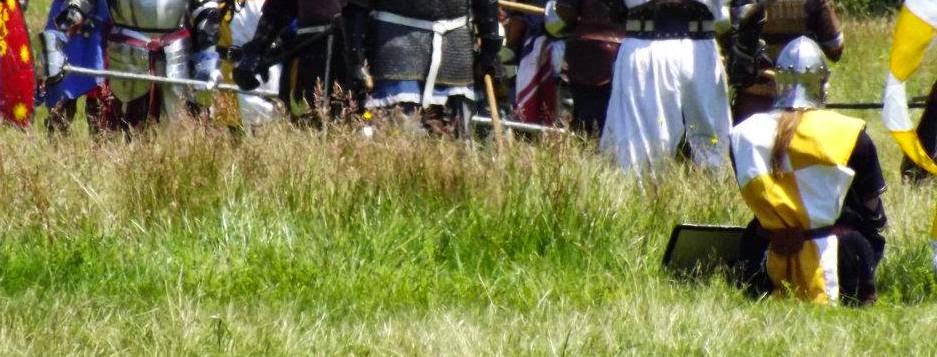
The fight starts before the armor, before you pick up your stick, and before you step onto the field. It begins with an individual that is devoted to himself and understands the gravity of taking up arms against his fellow man.

Monday, March 24, 2014

On 4:40 PM by Unknown in     No comments

I had not thought of this previously but when my Knight talks to us about plans in a fight he is talking about the OODA loop This theory was developed by Colonel John Richard Boyd, (January 23, 1927 – March 9, 1997), a United States Air Force fighter pilot and later Pentagon consultant, whose theories have been highly influential in the military, sports, business, and litigation . According to Boyd, decision making occurs in a recurring cycle of   observe-orient-decide-act. If an individual or organization can process this cycle quickly, by observing and reacting to unfolding events more rapidly than an opponent,  they can thereby "get inside" the opponent's decision cycle and gain the advantage(1).


Since decision-making occurs in a recurring OODA loop cycle, this strategy allows you to continuously move from one loop to the next. Recognition of an evolving situation and by quick adaption of a strategy along with an obscuring of your intentions, by making them unpredictable to your adversary, will allow you to operate at a faster tempo.  This enables you to generate some element of confusion and disorder which forces your adversary to clarify his intentions, (i.e forces them into an offensive maneuver).  By allowing some chaos and confusion to enter the situation, the use of this strategy throws chaos in the direction of your adversary thereby giving you control of the encounter.


A notable piece of advice:
Fear comes from not being in the moment of here and now. It is thinking too much of the past and extrapolating it into the future, that creates fear and distorts reality. There is no room for fear or deception in the immediacy of here and now. You either deal with what is coming at you or accept it.


References


Sunday, June 9, 2013

On 3:54 PM by Unknown in     No comments
Two years ago I made a Quick pair of greaves and decided recently to construct a new pair to match my new set of armor currently under construction.  As with all things armor they ended up taking much longer to build than expected, but the results were well worth the extra time.


The construction process was a series of small steps and meticulous measurements.  Fortunately a picture is worth a thousand words and my tiny digital camera captured the series of steps as follows.


Step One: Leather blank cut from 15oz, 1/4" thick, cow hide. Measured the length of my shin and determined that 10" slats would provide the greatest area of coverage for my lower leg.  My good friend, who works in a metal shop, was kind enough to make the slats for me.  I took a pattern from my previous set of greaves, from two years ago, and tweeked it to fit the slats evenly.  In the bottom picture, everything measured out together to make sure the plates are evenly spaced. At this stage I marked the position of the holes on the top and bottom.


Step Two:   All-in-one brown leather dye to colour and protect the leather. I also conditioned them with Lexol leather conditioner.  
From the back of the product:  Lexol protects old and new leather from cracking and premature aging by providing the lubrication necessary to keep it strong and supple. It is made with the finest tanning oils which are emulsified into microscopic droplets.

The picture on the bottom is a dry run before setting the rivets to make sure everything was lined up and ready to go.  As it turned out some of the holes needed to be drilled out again since the rivet width varied slightly.


Step Three:  A goal of mine is to step away from modern buckles and use replicas where I can.  These buckles were purchased from Bronzehammer and I have put them to good use to secure the greaves to my lower legs. On the left you see the various stages of completion while setting the size 14 copper rivets.  To the right the tape is holding the rivets down. A nice little solution to the frustration of keeping the whole mess together while setting the rivets one by one.  Also a nice close up of the bronze buckles.


And at last after setting all 30 of the rivets to secure the slats, buckles and straps.  Completion!!


Friday, March 22, 2013

On 12:10 PM by Unknown in     No comments

As quoted by my squire brother:   "Guess I should stop smiling before and during fights."

This article is a valid read for everyone that ends up on the field primarily because it goes to show that nonverbal behavior is powerful simply because it affects people on a subconscious level.  While this study focuses on the cause and effect of facial expressions and their predetermination of fight outcomes, it brings into question how serious a competitor needs to be to find success on the tournament field.


http://www.krauslab.com/UFC.Emotion.inpress.pdf


Naturally some discussion started, so here is the break down. Human behavior/psychology is a wide field, please add in if you have something to contribute
  • U: I think this paragraph is more pertinent, "Consistent with the researchers' predictions, fighters who smiled more intensely prior to a fight were more likely to lose, to be knocked down in the clash, to be hit more times, and to be wrestled to the ground by their opponent (statistically speaking, the effect sizes here were small to medium). On the other hand, fighters with neutral facial expressions pre-match were more likely to excel and dominate in the fight the next day, including being more likely to win by knock-out or submission."
    because I believe either smiling or snarling probably indicates a bit of inability to focus or lack of training to focus the mind.

    Also, this study makes a false cause and effect relationship. All they established is there may be a correlation between facial expression and success rate.

  • K: I scanned the PDF of their study. It seemed to me they correlated smile intensity to not only win/lose, but also effectiveness of their fighting. They even make a note that the fighter who smiled less actually ended up preforming better. Possibly because they perceive their chances as better against a less aggressive opponent. I thought their win/loss chart would show only a slight change, but it looked to me to be significant.

    The nice thing about the way this study was conducted is it used data (pictures and statistics) that were already available. They only needed to rate the fighter's smile. The sample size of 152 fighters seems small.

    So even if you like to smile in front of an opponent, doing so may end up giving them a real advantage you don't really intend.

    http://www.krauslab.com/UFC.Emotion.inpress.pdf

  • U: I still don't think the cause and effect is shown, based on your description. I think it much more likely that losing and smiling are symptoms of a root cause. So as a indicator for chance of success it may be fine, and as a tool for training it may indicate an issue with the trainees confidence, and it may be as you say a bad subliminal queue to the opponent but that is pure speculation and not indicated by the information. If I am correct and one falsely believes it is all about the smile and not about a root cause one is likely to lose anyway.

  • U: This covers all the bases I think. People respond to smiles and smiles could indicate many things other than "Hi, glad to see you."

    6. People smile when they're happy. People smile for all sorts of reasons, only one of which is to signal happiness. E
    kman describes many kinds of smiles, from the "felt" or true smile to the fear smile, the contempt smile, the dampened smile, the miserable smile, and a number of others. Daniel McNeill, author of The Face: A Natural History, says, "Smiling is innate and appears in infants almost from birth....The first smiles appear two to twelve hours after birth and seem void of content. Infants simply issue them, and they help parents bond. We respond; they don't know what they're doing. The second phase of smiling begins sometime between the fifth week and fourth month. It is the "social smile," in which the infant smiles while fixing its gaze on a person's face."

    Whatever their origin or motivation, smiles have a powerful effect on us humans. As McNeill points out, "Though courtroom judges are equally likely to find smilers and nonsmilers guilty, they give smilers lighter penalties, a phenomenon called the 'smile-leniency effect.'"
    -- http://hbswk.hbs.edu/archive/3123.html

    So we need to knock the smile out of you, not just get you to focus on not smiling.

    I think a study would also show that the person who is concerned about their opponents well fare, apologizing for illegal shots, or stopping to chat during competition is even more likely to lose.


    M: Throwing in some basics from animal behavioral and human physiology courses I’ve taken over the past few years.   

    People try to assert their dominance in many different ways; their nonverbal behavior is powerful simply because it affects people on a subconscious level.  It is not resisted as much because it’s less noticed than verbal aggression.  Primate behavior is a good indicator of how human hierarchical structures work as well, which is why that study that dealt with multiple chimps attacking an alpha leader was such an odd behavior for a wild primate group.  By this I mean there is no gain to attacking in groups because it injures all the most dominant, group protecting males.  Though it does show a nice dichotomy between instinct and intelligence, in relation to adaptive behavior.   

    I know the study focused on facial expressions, by I’m curious about the individual’s body postures as well.  Common dominant human behavior includes physical positions that take up a lot of space or make a person look bigger.   For instance, stretching arms out to one’s sides or placing your hands on your hips; extending legs or widening knees in standing or seated positions; and standing or sitting on a table while other people sit lower down.  Also to tie it back to facial expressions, angry like eyebrows drawn across the face in a long, thick line.  Think of military recruitment posters and the serious faces of the soldiers in gear. Do the fighters in this study tend toward any of these postures pre-fight or are they all staged, making the fighter respond to other stimulus and thus respond unintentionally to non-verbal behavior from other sources rather than their opponent.

    Submissive displays vary from head tilting, bowing, and nodding to demurely crossing ankles or pressing knees together are also an awesome look at expected female behavior.  The dichotomy here is that it’s not a dominant move for women to sit with their legs wide.  When men display these traits it incites more aggressive dominant behavior from other males.  Weirdly enough crosses arms isn’t always a good behavior either since depending on the situation arm crossing is perceived as submissive because it makes a person look smaller and self-protective.  I’m not sure on this one because it does make you look smaller and less outwardly aggressive, but I guess this is also where the facial expression would definitely matter.  

Monday, March 18, 2013

On 4:09 PM by Unknown in     2 comments


Distance, Time and Line

Sir Gemini from the West Kingdom taught a class this weekend that focused on three core points:  Distance, Time, and Line.  In other words,  Distance from your opponent, the Time it takes to reach your optimal range for throwing a blow, and your relative position to your opponents center Line.

Drills:  pair up, one defends and one attacks.  stay in your optimal range and be able to throw with one small half step a blow that can kill your opponent.  This helps build memory for range during a fight.

Line: relative location to the opponents center line.  keep shield/fist angled at opponents weapon/hand, basically beating the angle before the blow is thrown at you.


Other points:

There was quite a bit of information past on during this class and I found myself getting a bit over-whelmed trying to process everything.  My knight and I ran through the topics a second time, the week following the class, to figure out how this knowledge could be integrated into my fighting.  While the underlying concepts are similar to what I am learning right now, it was the exchange of explanations for fighting actions and positions into common terminology that was a huge take away from the class.  

Movement, never be stationary unless you want to let your opponent kill you. Patience ties into timing.  There is no reason to jump right in belly to belly, this may be a poor strati gum if your opponent is larger and heavier than you.  Considering my size, movement and timing are my best friends.

Monday, February 4, 2013

On 2:24 PM by Unknown     No comments


"I'll find strength in pain and will change my ways
I know my name and it's called again."


It's about the bigger picture.

Look at the kingdom as a whole. You'll see a collective of arts, sciences, and martial skills integrated and run by officers, volunteers, and participants.  Building relationships within the kingdom and community extends the longevity of the society and aids in self-advocacy.  It promotes a bond between people and a strong sense of belonging.  This is the unity that holds the fighters of our kingdom together.  It stirs pride in our hearts, and makes us fierce with the knowledge that our actions prove our deep desire to keep this kingdom great. 

Thus is it with great importance that a fighter looks within themselves and reflects on this question.  

Why do I fight?


Sunday, November 18, 2012

On 9:24 PM by Unknown     No comments


The fury of a fight is dominated by adaptation, flow, and technique.  It is the opponent who can maintain his calm within a flurry of blows that most often finds success against his opposition on the field.  Commitment and focus are the driving forces that bring these things together.


Also, this quick checklist:

  • Never turn your back on an opponent
  • Keep your arms up and ready to block
  • Keep arms in tight to block
  • Be wary of your range
  • Don't cover up too much. Block and return blows
  • Don't telegraph your blows
  • Don't lean back to "dip" incoming shots.  Use good footwork and motion.
  • Never cross your feet it puts you off balance.
  • Keep your shoes tied tight
  • Keep your head up, chin tucked, and eyes on your opponent.
  • Throw blows straight, not hay-maker style.  It telegraphs and damages your shoulder.
  • No sloppy shots.  Use technique, step in with your leading leg and keep your head up.
  • Don't hesitate.


Friday, August 31, 2012

On 10:23 PM by Unknown     No comments
"believe, behave, become" -- Sir Octamasades
The concept per se is simple but the implications are far more important. 
Believe: Hold in your heart the desire to become a knight 
Behave: Actions and perceptions, strive to uphold the behaviors of knights on and off the field.
Become: When belief and behavior become a passion that is no longer a secondary nature.
 

Wednesday, August 22, 2012

On 10:24 PM by Unknown in     No comments
Training as a fighter takes time and consistency.  Fixing the small things, like the angle of your hand or elbow placement, can determine the success of your blows.  I've been frustrated by the lack of power in some of my blows recently until my knight and I discovered that my sword was the wrong length.  There is always the expectation to adapt to whatever weapon you are currently wielding, but honestly it's more important to find out what works best for you first.  There is a height/weight ratio for sword length where the balance of the sword is optimal for the style of fighting.  In my case, being in the lightweight column with low upper body strength, using a short sword is great for moving in and out of range but can be difficult to provide powerful blows constantly.  I recently switched to a sword that is 3 inches longer with a bit more heft, and haven't looked back yet.

Something to be said about swords in my Kingdom, they are hefty.  In fact we often fondly call one of our local knight's swords, "boat oar".  It was, in fact, planed down from a 3 1/2 inch piece of rattan and has continued to inspire quick foot work......Anyway, considering the overall weight, sword balance becomes more important to help prevent shoulder, elbow and wrist injuries.  Failing to use good body mechanics during a fight, especially with an improperly fitted sword, will cause a lot of wear and tear on the body. So make sure you find something that works for you!  


Quick Notes:  Keep elbow tucked in, follow the momentum of the sword.

Thursday, July 19, 2012

On 4:20 PM by Unknown     No comments
Yesterday evenings pel session, with my knight and squire brother, took on a different focus.  Using the iPad app Coach's Eye we recorded series of blows on the pel, for each person, then discussed with instant video review.  The beauty of this app is the ability to break down the video frame by frame and the option to draw freely on the screen.  By watching the slowed video any shifts in weight, miss steps, and poor hand/arm positions become instantly noticeable and can be pointed out with the draw feature.  By recording multiple sessions any recurring bad habits can be addressed and the scope of training immediately shifted to correct the mistakes. 

Wednesday, July 11, 2012

On 5:34 PM by Unknown     No comments
The wolf of the land howled and horns sounded, sullen and soaring.
Men of oak took up asps tongues and sharp, earth bound ore.
Adders of the sea swept the sail road, ready raven's food.
And red wound-flames rent the cold tumult of the corpse-scathe.
 

For five days two kingdoms meet for War.  On the coast brave battles are fought and won, and heroes honored for their great deeds.  Unlike tournaments, wars rely on group tactics, nerves, and a variety of ranged/pole arm weapons.  With a sword and shield it is often better to stay in a tight group and hold a position than to engage to opponent.  Pikes, archers, and raiding units break up the enemy line allowing for the advancement of your own troops.  After this year I've decided to per sue the use of a bow and/or spear to be more effective in battles that favor the press.    

Fighting all day for two days straight was a blast.  I've never been more tired or pleased with myself at a fighting event.  Learned a few things about expectations and how to follow my own desires and heart along the way. Less worry about living up to expectations and more focus on personal potential.  My road, my path, my "bucket". 

I have a wonderful support system that is helping make my dream a reality. 

Tuesday, June 19, 2012

On 11:09 AM by Unknown     No comments
"Often we measure the path to greatness in successes and failures. We rejoice in the things we have accomplished and bury the things we have failed at. Can we succeed in failing?"


After a hearty chat about the positive aspects of failure.  Failure to perform a blow properly, loss in fights, etc...the conversation picked back up on the topic of frustration at our last training session.  My squire brother and I were practicing combination drills on the pel with varying degrees of success.  About half way through my second set I was getting very frustrated by the drill.  My knight took the time to point out that this wasn't a negative thing.  Getting to the point of frustration in a practice environment brings you up against your mental fortitude and provides the opportunity to work through the problem in an coach-able environment.

Last night at practice I realized that my lack of explosive power often comes from mind set rather than physical ability.  At practice I tend to think more about how I am performing rather than clicking into fighting mode right away.  To combat this I've decided to fight fewer fights over all.  I'll fight hard with each person about 5 times before clicking into training mode.  This way I can teach myself to trust my instincts more, think less and act more, and adapt to the flow of the fight rather than just think about it. 

Tuesday, June 5, 2012

On 10:49 AM by Unknown     No comments
The combination race training and armored combat drills have had a dramatic effect on my fighting.  I can push the intensity of my fights and focus more on technique rather than worry about muscle fatigue and shortness of breath.  Without having to focus so much on physical limitations my mental game is free to adapt to different situations as they arise.  I found that my ferocity is greater but needs to be fashioned into more deliberate actions so I can take more control of the fight and shut down my opponent.

More as a note to myself, I need to be more aware of my opponents foot placement and the blow options that arise from them.  This includes positioning for offside set ups in particular and leg fakes....
I discussed at length with one of the Knights last night how to defend and retaliate against some of these situations, and have decided to practice throwing blows from a legged position to improve power and defensive postures.  Summary on these drills to follow after completion later this week. 

Sunday, June 3, 2012

On 7:28 PM by Unknown     No comments
Thirteen days until race day. 

The weather was excellent and the four of us, being sick of the gym, went out for a trail run.  Never minding the distance, we ran for two hours over hilly terrain, climbing piles of logs and navigating overgrown trails.  At one point we secured a thick rope and took turns practicing climbing techniques between bouts of push ups.  Over all an excellent workout and more satisfying than a treadmill could ever be.  I recommend it heartily.  

Monday, May 21, 2012

On 9:00 AM by Unknown     1 comment
This video is not very long but presents a few topics that are worth discussing. 

Here is a quick run down of thoughts I came across:

He didn't go into the theory of plateaus much and how they operate with cognative plasticity. Generally you reach a mental plateau when the skill becomes well set into the autonomous stage, however it also means that you have reached a point where how you are learning the skill has peaked with how well you can process a particular subset of information. This is why, "changing it up" or practicing weaker skill sets causes more constant improvement. Actual linear plateaus don't exists if you are constantly trying to improve, only the slope of the learning curve (which is different of every person).

The brain has a natural tendency to rehearse new information, even more so with things you find interesting, and progressively fix it more and more into your memory. The idea of being "driven" improves the amount of information entered into your memory as your brain will change physically to accommodate it. This is called sensory upgrading if your interested, where there is an increase in pre- and post-synaptic neurons that help establish stronger long/sort-term memories.

Also, and yes instructors you'll get a kick of of this, cognitively humans respond more rapidly to fear/pain and learn faster. These negative responses will over ride pleasure/reward aspects of the brain every time. This is why critical comments that break down failures with our fighting help us learn more quickly rather than complements, which lull us into more of an Autonomous stage and decrease the level of improvement overall.  This ties into a previous post, on being coach-able.
(My knights response to this: I was thinking that perhaps it is time for the squires to spend a few months fighting off hand )

With out actually mentioning the term visualization he did talk a bit about it. By geeking out and recording patterns, that he found within more successful writers texts, he was able to improve his memory/writing by working within these noticeable subsets. His over all abilities changed because he was able to adapt by visualizing how they needed to be change.

My Knight's Thoughts:
Consider if there is value in spending 20 minutes a day visualizing (replaying) a difficult or failed engagement. This is not studying video (a different and valuable tool also allowing study of the masters as well as personal failure) but rather closing the eyes and being in the fight again. Visualize and feel the execution of variations on your original actions. Try different weight balance, on guard positions, foot motion, hand and elbow positions and motions.... It should be difficult or impossible not to have the body responding to the replay.

I think the other key point that I missed emphasizing is the "study yourself failing." Failure for the sake of failure means little and failing as an excuse against learning should be anathema to the student. What do I mean by this last bit? When another advises and the response is a rejection of advise because the student is focused on failing, I think the point of the failing is missed. The point is to push the envelope of skill and skill set to the point of failure, analyze (and accept analysis) and adjust.


Thursday, May 17, 2012

On 3:11 PM by Unknown     No comments
Life is a hard mistress and I will be missing the Crown Tournament this weekend.  Good luck to the top contenders!!! I look forward to greeting our new royalty.

This Saturday I'll be competing in my second 5k mud race.  To remedy the mistakes of the first I come into this with better shoes, New Balance MT10,  and a new set of compression running gear.  The Minimus shoes offer light weight, snug fit, quick drainage for mud and water, as well as good traction.  So far they have performed very well.  Unlike the first race, as an individual competitor, I will be competing as part of a 4 man team.  Our overall score will be an average of the first and last members of the group to cross the finish line.  We've all been training and will be able to top our old score of 45 minutes.   Even though our fitness strengths vary, staying together and dominating the obstacles will be no problem.

Mind-over-matter.  The desire to dominate the course successfully will pull the team through.  This race is the month marker for the Spartan Race in June.  It will indicate how far all of us have come and how far we need to go before that race.  It is crucial to continue the race training uninterrupted.  This Race on Saturday will look like a cake walk compared to what we will experience in June; A brutal, hilly run, combined with such obstacles as a 500-800 meter barbwire crawl.....

How you might ask does all this relate to fighting.  Perseverance, intensity, fitness and learning personal limitations are just a few of the benefits.  Great feats of physical prowess,  this is how we offset sword training, because in the gym you can't leave your competition in the mud....      

Thursday, May 3, 2012

On 11:16 AM by Unknown in ,     No comments
I've increased the intensity of my workouts and switched to more of a CrossFit style that focuses on both strength and conditioning.  The constant varied, high intensity, movements are aimed at improving general physical preparedness across a broad range of times and situations.  These workouts are typically short, 20 minutes or less, and demand all-out physical exertion.  They combine movements such as sprinting, rowing, weightlifting, and rope climbing as well as plyometrics and other exercises that rely on body weight.

To improve my cardio I run everyday.  Not the same distance mind you but consistently to ensure my body adapts and grows the capillaries I need to stay strong throughout a race.  I've found a pace that I can keep for over four miles, approximately 9:45 minutes per mile, which is not where I want to be but the stability throughout the run is more important right now as I train my knees to deal with my activity level.  Monday was my rest day, so on Tuesday I ran 4.5 miles in 40 minutes.  Yesterday I did 20 minutes of HIIT, or high intensity interval training, on the elliptical and managed to shave 40 seconds off of my 2.25 mile run time.  Overall I'm please with this result.  This means my 5k race time should be much better, and that defeating the obstacles will take less time.  I also stretched well after the run to keep my muscles from becoming too stiff with all the back-to-back workouts I've been doing.

Nutrition is also in the forefront of my mind.  I burn quick and need to remember I'm not doing this to loose weight but to gain muscle and strength.  It is difficult for me to increase the amount and type of foods that I need when I see friends slamming protein shakes instead of eating meals.  Their calorie intake is not MY calorie intake and I need to remember to focus on what is best for my training not just what everyone else is doing. 

Sword training is moving forward.  If I can get my body to catch up with my mind I could have a bit more synergy during my fights.  Working on the pel is helping greatly.  Here I can go through the blows slowly, pick apart footwork, body mechanics and hip shifts all of which are slowly becoming muscle memory.  It's definitely a bit of a grind but the results are well worth it.  Getting a camera set up so I can post videos of training/practice sparing/etc..as well as learn how to critique them.  Comments in the future are encouraged.

Tuesday, May 1, 2012

On 2:27 PM by Unknown     No comments
I'm almost certain there is nothing worse than attending a large practice and needing to sit aside the fighting due to injury.  It was really really difficult to stand there and watch everyone.  I could feel my willpower slipping as my mind diverged into two paths. 

(1) gear up and fight.  Hope no one hits me in the arm.
(2) leave

So voicing my irritation to my knight yielded a frustrating but useful third option.

(3) observe.  Watch footwork and body motion, compare to skills I've learned on the pel and in gear.  Not the option I wanted to hear but the one that helps build observation and understanding of movement and blow placement within a fight.  Oh, and that patience thing.

Some other thoughts:
Keeping a cool head in a fight.  I don't mean anger but control, the ability to not become caught up in the fight and forget technique.  Some times when I get really excited about fighting I want to rush in head first and pretend like I'm a  6'4" and 250lbs. The end result is usually pretty humorous if you've ever watched me spar.  To control this I've been focusing in keeping my elbow tucked into my body, to reduce flailing/blows that are all arm, keeping my footwork active, and being aware of range.  There is a lot going on during a fight.  By continuing to drill these things into my sub conscience I hope to worry less about what my body is doing and more about what my opponent is up to.

Wednesday, April 25, 2012

On 10:13 AM by Unknown     No comments
Due to a surprising turn of events, and a reduced entry fee, I will actually be running the Spartan Race this year!  It takes place on June 16th which gives me a little less than two months to get into tip top shape.  I will need to focus on cross-training as unlike your typical 5k this race is a combination of workout drills, obstacles, and trail running.  Fortunately the push for this race overlaps with this years Crown Challenge and I can train for both simultaneously to increase endurance and over all strength.  The beauty is, I found this great site with a list of Military Workouts I'm going to work my way through over the next few week.     

The workout today is as follows:

1 mile run
1/4th mile running 
10 burpees
1/4th mile running
20 push ups
1/4th mile running
20 squats with 10 lbs weights in each hand
1/4th mile running
10 push up rows
1 mile run
Core work out
Stretching