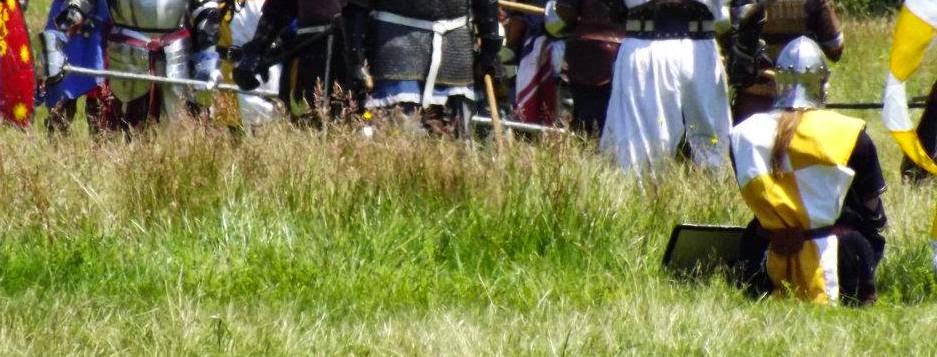
The fight starts before the armor, before you pick up your stick, and before you step onto the field. It begins with an individual that is devoted to himself and understands the gravity of taking up arms against his fellow man.

Wednesday, October 5, 2011

On 5:30 PM by Unknown in     No comments
Mental Models: Impact on training, sparring, competition

When approaching an opponent it is good to have a plan, one that addresses the size, speed, and ability of your opponent.  Noticing distinctions allows mental skills to be developed and perfected. Much like physical skills, mental skills, can be thought of as a three-phase process (Fitts and Posner 1967).
  • Cognitive:  focusing on the nature of the task.
  • Associative:  development of better (1)proprioception and (2)kinaesthetics:  or (1) an awareness of body position, location and orientation as well as movement of the body;  (2) an awareness of the muscular movements of the limbs and body.
  • Autonomous:  making this an unconscious process


The cognitive assesses the nature of the threat in front of you without being overwhelmed and "receives what comes", or is ready to handle what your opponent throws at you.  It is important to not focus too much on previous fights or future fights as it distracts you and separates the physical and mental connection needed to focus on what is happening right now. Through this we create mental models that shape expectations within the fight.  We analyze, compare, contrast, evaluate, synthesize, reject ideas or integrate those we choose to retain. This can impede or advance our mental model and overall mastery of the skill set we desire to learn.

The development of better proprioception and kinaesthetics comes from an understanding of how biochemistry works within the brain.  However, this can also be referred to as a fight or flight response coupled with lots of practice.  Understanding and analyzing opponents movements and reactions are one thing, but without actually sparring to familiarize the brain with repetitive body movements your chances of improvement in these areas is low.  This ties heavily into the autonomous process.  The combination of cognitive assessment and associative integration lead directly into the autonomous process.  This means we make sense of the sequence and connectivity of events, and our interpretations of them, and act based on our physical familiarity and mental model of a situation.


References:

FITTS, P. & POSNER, M. (1967) Human Performance. Belomont Brooks

Tuesday, October 4, 2011

On 5:00 PM by Unknown in     No comments
First of eight two hour sessions, over four weeks, starting tonight.

First up, Movement and Mental Models.

The general schedule of the session is as follows.
1. Mental models – impact on training, sparring, competition
2. Stance, balance and movement
Why movement may be good (changing target, better reactions), and some perils (self-awareness, stamina, reaction delay and location prediction)
3. Defense – Shields
4. Defense – +weapons
5. Distance, Perception and Readiness
6. Striking – force, angles, point A-B
7. Striking – sequences, timing and flow disruption
8. Future training goals, objectives, plans


www.youtube.com
Tiger Muay Thai and MMA training camp, Phuket, Thailand Master instructor Kru Yod teaches Muay Thai boxing technique in stance, movement, balance, and striki...

Tuesday, September 20, 2011

On 10:39 AM by Unknown     No comments
It's frustrating.  It's disheartening.  It's poor performance in a tourney.  With a crushingly low success rate during the round robin portion of a tournament, I've been searching for a reason or an excuse to console myself.  Basically whining away the hours until I realized that a low win to loss ratio doesn't always reflect on the quality of your fighting.  Some times it just means you've been getting better.  The threat presented is much greater as the hours of practice you've been doing being to prove that the dip in the couch has been missing you. This ultimately leads to upper tier opponents taking you more seriously and thus taking you out much more quickly.  There are always ups and downs.  It's important to realize this and not loose focus.  

Tuesday, September 6, 2011

On 1:20 PM by Unknown in     No comments

After a bit of hit-and-miss, one country away and a move later, my new leg harness arrived! It's been a bit of a jumble trying to coordinate from person to person and event to event to make sure the leg harness and I ended up in the same place at the same time.  Whew!


These are high impact plastic laced together with 550 parachute cord.  The knees are of the same plastic, and friction welded together down the front of the kneed cop.  All in all they weight less than any harness I have ever owned, and should last a very long time.  Unlike the blue plastic pickle barrel, the high impact plastic is much thinner and will require more strategic padding.  I intend to line these with neoprene, i.e wetsuit material, and wear some hexpad shorts as well if needed.

New leg harness also means new hip belt.  I have been using a standard weight lifting belt in place of this since that is what came with the other harness I've been wearing.  Not the best belt for anyone, women in particular.  The edges of the belt end up digging into the top of the hip bone and/or put pressure on the lower back causing pain.  The C-belt pattern accommodates the natural hip shape as well as distributes the weight of the leg harness along the core of the body rather than centering it on the lower back.  More on this later when the belt has been completed!

Friday, August 26, 2011

On 11:13 AM by Unknown     No comments
Some times finesse goes right out the window.  A flailing mess of poorly thrown blows, a bull rush, an utter lack of exploiting your opponents openings...etc.  It's not a lack of practice, but a lack of patience and mental focus.  Experience can go along way when performing controlled actions within a fight.  Knowing when and how, as well as feeling the movement and flow of the match determines the options available.  For example throwing a few head shots can force your opponents shield upward opening up a leg blow.  While not the most complex of combinations it can be successful frequently if timing and position are good.

Knowing how to engage an opponent is one of the most difficult things for me.  I never know how to begin.  If there is a plan in mind will it be telegraphed, will my defense fail, will my focus falter the longer I stand there.....which is the heart of the matter.  To much thinking, not enough commitment or confidence in my skills. 

Wednesday, August 24, 2011

On 10:49 AM by Unknown in     No comments
Along the path to achieve a better kit, a more period representation of actual armor and clothes, a few friends had a plan to build a viking pit house.  Fortune was in their favor with the availability of land, cedar, and a dozen shovels ready to dig.  On the first of the week they dug, and dug and dug.  Chopping through roots and handing buckets of soil up out of the pit at a breakneck pace. 

"A house!" they cried. "we will dig until it is done."

Preparing the wood, mid week, turned out to be quite the job as well.  The chain saw was only usable part of the time and several logs were split by maul and axe.  That in its self is no small task my friend.  The wood must be watched to make sure it splits evenly along its axis, while the mauls are moved slowly up the length to keep tension on the split.  I'm no logger so I took video to show you what I mean.

Setting to posts was simple.  Those not splitting the longs had dug the post holes in preparation, and long steel nails were driven deep into the wood for stability and longevity as the frame began to take shape.  Once the frame was set in place our minds bent toward roofing.  And up the roof went, that is all I can say.  It was paneled, tared, framed, and covered with the extra dirt from digging the pit.  Having never roofed I just dug and poured extra dirt for the eventual sodding.

Here the construction stopped.  Time had run out and more materials were needed to finish up the walls.  Planks will be nailed to the exterior part of the frame and the remaining dirt from digging the pit will be shored up against the structure.  This will help regulate temperature, cooler in the summer and warmer in the winter.

To take a better look at the building of this project please take a look at the link below.

Viking Pit House!

Monday, August 22, 2011

On 4:41 PM by Unknown in     No comments
Every two years the Kingdom of An Tir hosts an event called Sport of Kings.  This is the penultimate event.  So much time, effort, and money is spent to improve and maintain armor, garb, camp, and travel vehicles that when gazing down the rows of hand painted silk flags one can only desire the opportunity to become a grand champion.  The grandeur represented by this event is reason enough alone to strive on the off years to become a hero.  As a squire it represents an open forum where I can receive helpful critiques from a wide variety of instructors, show knights progression in my fighting, and connect with people from other kingdoms.  
 
Don't believe me...look at some of the photos.

Here is a taste:


http://talentus.smugmug.com/SCA/20110820-Sport-of-Kings/18655603_zxktGH#1442053455_dP3jZj7All of these photos are copyrighted.


http://www.sportofkings.org/

 Sport of Kings: Academy of Armored Combat, August 18-21, 2011 Barony of Three Mountains, Portland, Oregon

"Sport of Kings: Academy of Armored Combat" is a four day learning event presenting to students of all interests and backgrounds, an opportunity to learn about the activities that support and glorify tournaments.  It is an opportunity for aspirants to martial skill to learn from accomplished practitioners.


Thursday, April 7, 2011

On 5:22 PM by Unknown in     No comments
The more we delve into technology the more we focus on using it to spread ideas.  I'm always a fan of instructional videos, with work and school hounding my heels constantly I don't always have time to meet with members of the Chivalry for training.  It is a real treat to observe and study techniques from knights in other kingdoms and see how they relate to the style in my own kingdom.  This way, when having discussions with my knight, I can use my observations to try and add some thing to my tool box.  Recently brought to my attention, via Facebook, is this site:

http://www.facebook.com/pages/The-Modern-Medieval/111670658864063

About :  Welcome to the Modern Medieval! The show that explores and explains medieval combat, arts and sciences, the concept of chivalry and how they apply to the modern day.

 These two links are the corresponding homepage and youtube:
  http://www.youtube.com/user/themodernmedieval
  http://www.modernmedieval.org/TV/Welcome.html


Sunday, March 20, 2011

On 2:52 PM by Unknown in     No comments
This is a fantastic fighting focused blog -- check it out! http://nakedswordsmanship.wordpress.com/

Friday, February 25, 2011

On 3:48 PM by Unknown in ,     No comments

Three tools of training!  

The first, that looks vaguely like a fraternity paddle, re-enforces on edge mechanics. When used to throw a shot it glides easily through the air so long as the thin edge moves toward the target.  When the mechanics are wrong the flat edge drags in the air, much like an airplane wing, causing the sword to move incorrectly.  

The second is an old sword stripped of its hilt, and used for pel work.  Pel work is important for learning muscle memory, throwing combos w/ flow, and learning recovery.  It's important to know how your sword rebounds so you don't hit yourself in the head.  When throwing combos move about and establish flow.  Your opponent doesn't stand still when your fighting so why should you practice your shots in a stationary position.  

The third is a light piece of bamboo with triggers.  This little whippy thing I use to practice new shots with and do slow work with a partner.  Since it's so light I can tap my practice buddy without fear of serious injury, and don't need to worry about hurting myself by throwing a shot incorrectly.  
On 10:42 AM by Unknown in     No comments
This month our fighting workshop guest was Duke Radnor from the West Kingdom.   He taught a sword/shield tourney centric class with focus on flow, form, and addressing the threat of your opponent.  The session was video taped and can be found here on youtube.  There are 10 videos in this sequence:

http://www.youtube.com/watch?v=20YH1tCbsw8

A new training exercise was recommended,  the Centurion Challenge.   Everyday for 100 days you throw 100 shots.  If you miss a day the sequence starts over again from day 1.  This promotes muscle memory, good form, and adds to training time overall during the year, which leads to better performance on the field.  Day one of this exercise complete!

Monday, January 31, 2011

On 10:07 PM by Unknown     No comments
In my kingdom a "tournament circuit" has sprung up in hopes of getting a badass group of people committed to participating in one designated tourney a month in an effort to raise the caliber of tournament fighting.  The tournaments have been chosen each month in a different location to enable fighters from all over the kingdom to have an opportunity to participate.

The rules of the circuit are as follows:

1. Email intent via email to organizers.
2. Commit to going to the tourney designated for each month. Only heavy combat tournaments count for points (you do not get extra points for also participating in an equestrian or rapier tournament at a designated event).
3. If you cannot go to one of the tournies, send two fighters (who are not participating in the circuit) in your place who actually fight in the tournament (and tell organizers who they are, so they can verify) OR donate to the prize chest. Donations to the prize chest should be hand made or worth $20 or more -- rattan is great, jewelery is great, rivits, buckles and leather are great; however, candles, incense, potpourri and duct tape not so much. You MUST make a donation to the prize chest (worth $20 or more) or send fighters in your place for each tournament you cannot attend.
4. You get one point for every tournament you attend. You get one additional point if you bring one or more fighters who compete in the monthly tournament, but who are not participating in the tournament circuit. You get one additional point for each tournament on the circuit you win. So, the most points any one person can earn per tournament is 3.
5. We are commissioning a wooden chest, which, along with all the donations to the prize chest, and perhaps one more commissioned prize, will go to the person who has the most points after the 2011 tournament circuit is concluded. Most likely to be awarded at 12th night 2012.


This month was the first of these tournaments, and happened to be one of the largest heavy fighting events in our kingdom.  Ursulmas, where the lists and intensity of the fighting is greater than a crown tournament.  The day consists of round robin format, 22 fights in each ring, a veritable marathon of fighting.  Not only is it a test of endurance, but strategy and skill in order to last until the end of the qualifying round. No easy feat, and a point of pride to make it to the end.


Monday, January 3, 2011

On 11:30 AM by Unknown in     No comments
My first year of training is coming to an end.  Here is a brief list of things in focus.


Basic stance


Basic movement in stance.  Also known as foot work.


Bull-in-the-ring.  Aggression and how to utilize it against your opponent.


Slow work.  Pel and Katas to build muscle memory.


Fitness.  Stretching and warm-ups.


Off the field conditioning.  Includes Diet and gym time.


Armor: Different types.   Sport, Period, and how to cover and repair both properly.


Mental game.  Why am I fighting? how much does this cost?!?

Monday, December 27, 2010

On 5:47 PM by Unknown     No comments
The Warrior


“It always happens that way. If one seeks to train under him, first he asks them to fight me, he does not give them a motive, or an outcome, should they win or loose. And I fight to loose, you saw, I swagger, I ignore openings, I allow myself to be beaten down. There have been many outcomes to this test. Some men berate me, call me a fool and insult the old man as they win. Those I am given permission to do with what I will, when they have gone too far, or show no promise. Some question the man’s stability and choose another path believing me a weak pupil, and thus the master weak as well, these men walk away. Others walk away for they would not fight a female or an assistant; they are the saddest of all. But some, like you, realize that it is cruelty to hammer a beaten opponent, you question the master, and thus, the test is won. And you saw, I am none too worse for the wear, for I can act and fool a man to believe me beaten. But there are a rare few too, who ask to start ‘why?’ they question why they should blindly fight an opponent with no motive those men have become some of his greatest pupils.”

Thursday, December 16, 2010

On 11:47 PM by Unknown in     No comments
As we all know our armor is always in a state of constant disrepair, and when we let this lapse for a long enough period of time it can lead to injury and disqualification from the tourney field.  This week I spent a brief period of time updating and upgrading a few pieces of my gear.   Remember these waxed leather bazubands: 

In regard for my arms metal slats were added for more protection.


(Note the effort used to hold said leather in shape.)

Taking a blow to the shins is an uncomfortable and somewhat irritating experience.  So, On To Greaves!

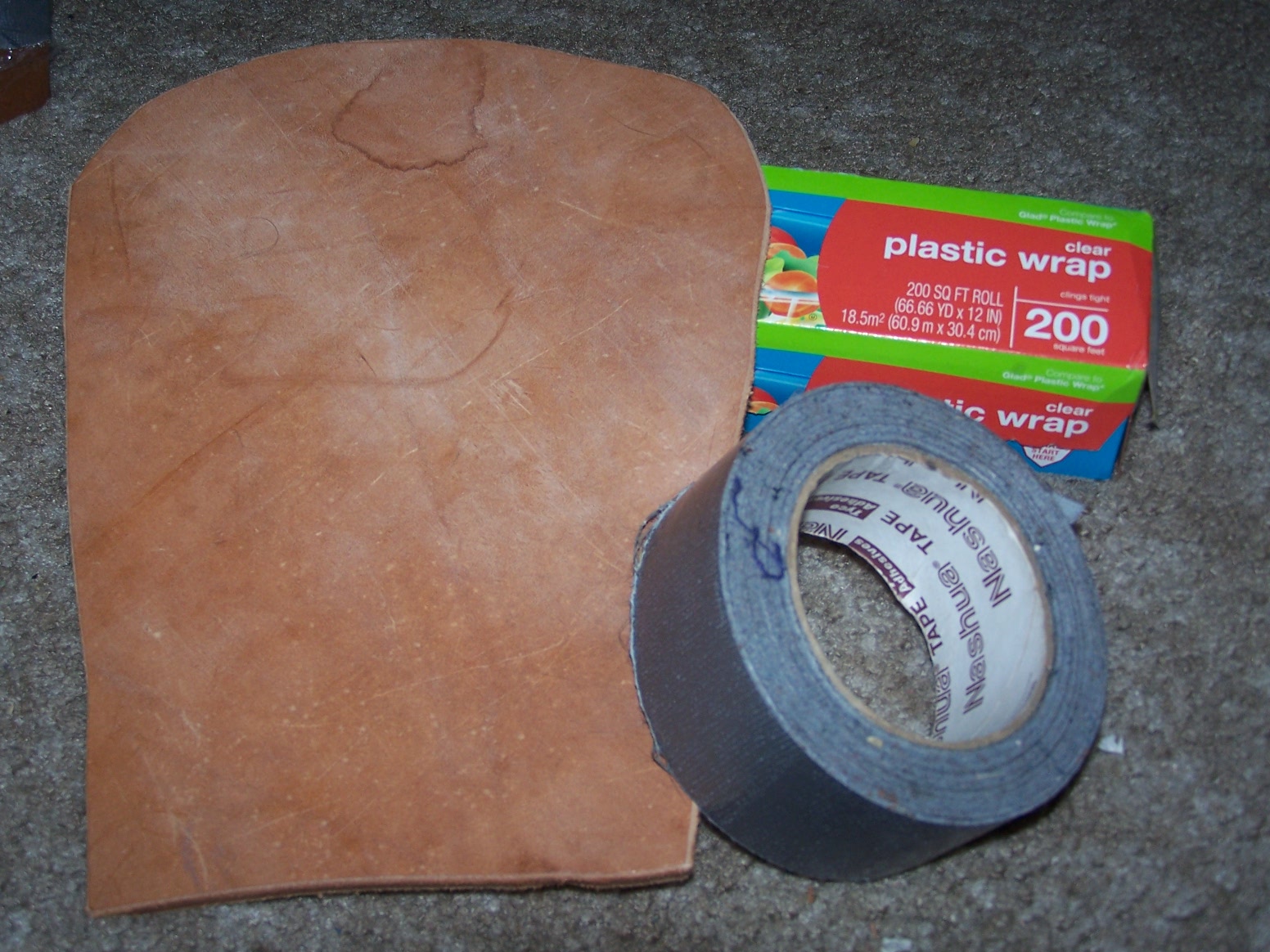
 After cutting my greave pattern out of 3/8s leather I realized it was really rather ridged in smaller pieces and needed to be shaped.  Standard simple soaking procedure is as follows:
 
(1) soak leather piece in water until saturated.
(2) place leather piece over/in mold and secure.
(3) let leather dry in mold and remove.


Materials
After soaking my leather I needed a way to attach it to my mold.  Some inquiring yielded a fairly simple solution.  While forcing my leather onto the mold I diligently fought embarrassment to cover it in plastic wrap.  This plastic layer protects the leather from the duct tape used to secure it in place on the mold.  Picture as follows. 


Leather secured on mold with tape

Friday, December 10, 2010

On 10:28 AM by Unknown in     No comments
With the completion of my fall academic term, and gradual recovery of mental fortitude after finals, it's time to dust off my helmet and step back out onto the field.  As glorious as my return is in my own head, queue cheers and banners waving in the air as I defeat one knight after the other, the reality will be much more like this.

Anyhow last night at practice a few of us discussed custom shield bosses available in Germany.  They are not accepting orders again until the end of January, to prevent large backups, but this gives me ample time to create a wish list.  enjoy!
http://www.rudis-kuenstlerwerkstatt.de/gallerie-helm-engl.htm

Monday, August 30, 2010

On 3:53 PM by Unknown     No comments
I've gone and gotten myself a proper dress squires belt. Has a hand carved lost wax cast bronze belt tip even!


To be honest I lost track of posting due to work, school, and practice schedules.  It's the usual BS procrastination blurb but there it is none the less.

Lately I've been participating in a one month Crown Challenge to prepare myself for the tournament with other folks from my kingdom.  Here is the information as follows, names excluded. 


 Crown Challenge -- One Month

Hello,

I'd like to challenge everyone (including myself) to do the best they can at Crown in September. How I think we can all do better is in our conditioning, preparation, and awareness.

So, I'd like to offer the following challenge:
Every day from August 5th until September Crown (Sept 5th is the day of the Crown Tournament) do one of the following:
1) 30min of cardio
2) 30min of gym/workout
3) 30min of pellwork
4) Fight practice or fight at an event
5) 30min of video study
6) Attend an event but no fighting

Obviously there are needs for breaks due to fatigue and natural body rest and this is why I have included the video portion, and ‘attend an event but no fighting’ (that and it is a great way to immerse and analyze fighting).
I’ll try to think of a suitable reward for those of us who can complete the challenge, and I would ask that if there is anyone you think would enjoy/benefit from this to please invite them to the group.

Tuesday, July 20, 2010

On 10:36 AM by Unknown in     No comments
Aannnnd like a stick shift being driven by a teen....stalled out. However getting back on track begins tonight with a little help from my knight:

Objectives repeated:
I'd like to switch gears a bit starting next week.

We have now gone through several iterations of drills
and have a set of folks who should understand the
goals and details of each one. These "old-hands"
can guide newer attendees if necessary.

So, next week as soon as you arrive and suit up and
have an available partner I want you to run through
a standard set of "warm-ups". During warm-ups let
us stay focused on action, keeping discussion of
action to a minimum (and save unrelated discussion
for afters at the pub).

Warm-up set
1) 5 passes of the retreat-side step
2) 5 Passes advancing on-side head
3) 5 passes advancing on-side leg
4) 5 passes advancing off-side head
5) 5 passes flow drill - focus on maintaining quality in
execution.

Note: One pass of a drill is a round-trip - one partner
exercising down the length of the training floor and the
other partner exercising coming back. For flow drill
one pass is an exchange of at least 20 blows between
partners.

After warm-ups, take a break. We'll give the last folks
to finish a chance to doff their helm and get some water.

Then we are going to work on three shot sets. This
is where the rest of the time is going to be spent.
I'll define a three shot action and we will set new
pairs to work through the initial understanding and
then hopefully finish with repetitions as time allows.
Each shot in a three shot set involves understanding
details of the foot placement, weight shifts, upper
body motion, hand placement, timing and flow into
the next shot.
Disclaimer: The three shot set is not something I
designed for you to use in competition, but something
I intend to teach your mind/body. It is possible a
set could morph into a standard offensive tool,
but that would be through your own efforts to
adapt one into your repertoire.

Sunday, May 16, 2010

On 10:37 PM by Unknown in     No comments
Following discussions about reaction times, with my knight and collective training group, arose this question: What can we do for our sport to specifically train our reaction time?

There are several webpages that can be found with general Google searches, here are a few of them:

http://www.brianmac.co.uk/reaction.htm

This one is about professional athletes using perception predict outcomes:
http://www.wired.com/science/discoveries/magazine/15-06/ff_mindgames

Here is "A Literature Review on Reaction Time" report that has a lot of interesting items on factors effecting reaction times:

http://biology.clemson.edu/bpc/bp/Lab/110/reaction.htm


Also, there is a difference between visual and audible response. Sometimes we have had the "trigger" person stand behind the pell with a 6 foot baton held ~12" above it, and the "go" was on the baton strike to the pell.

Yet another variation is to number the strike points 1-4 and the "go" is the call of which # to strike. This introduces decision into the reaction; Is the strike reaction fast and correct?
On 10:29 PM by Unknown in     No comments
The theme for last week was reaction, quickness and speed (which could be paraphrased as "explosive response").

On the pell, put a 2" square of different colored tape on each side of the "head" and on each "thigh".

1) The striker stands on-guard (use a shield) and says ready to the referee.
2) The referee waits a random 1-5 seconds and shouts "Go!".
3) The striker explodes their shot to hit the 2" target.
4) Repeat steps 1-3.
5) Repeat steps 1-3.
... (after 10 strikes at target)
12) Change target to the next tape mark and repeat 1-3.
13) Repeat 1-3.
...
42) Switch people and start over.

This yields 40 shots per person, 10 each at the four tape marks. The on-guard position does not need to remain the same, in particular, for the different targets.


Things to keep in mind:

This drill should occur early in the practice session when everyone is fresh. There should be some warmup work first (maybe 5 minutes of light striking combos per person). If you think the striking technique looks incorrect during the drill, work with that person to correct the technique in future practice sessions, before more training sessions.